
When rebuilding or constructing a new home, the Soil Investigation Report (SI) is one of the most important — and least understood — documents.
Many clients ask us:
“What’s an SPT N-value?”
“What kind of soil do I have?”
“Will it affect my construction cost?”
This guide breaks it down in simple, visual language — and helps you spot red flags, especially if you’re building on soft ground or encountering unusually high resistance.
Key Sections of a Soil Investigation Report
A typical SI report includes:
Section | What It Shows |
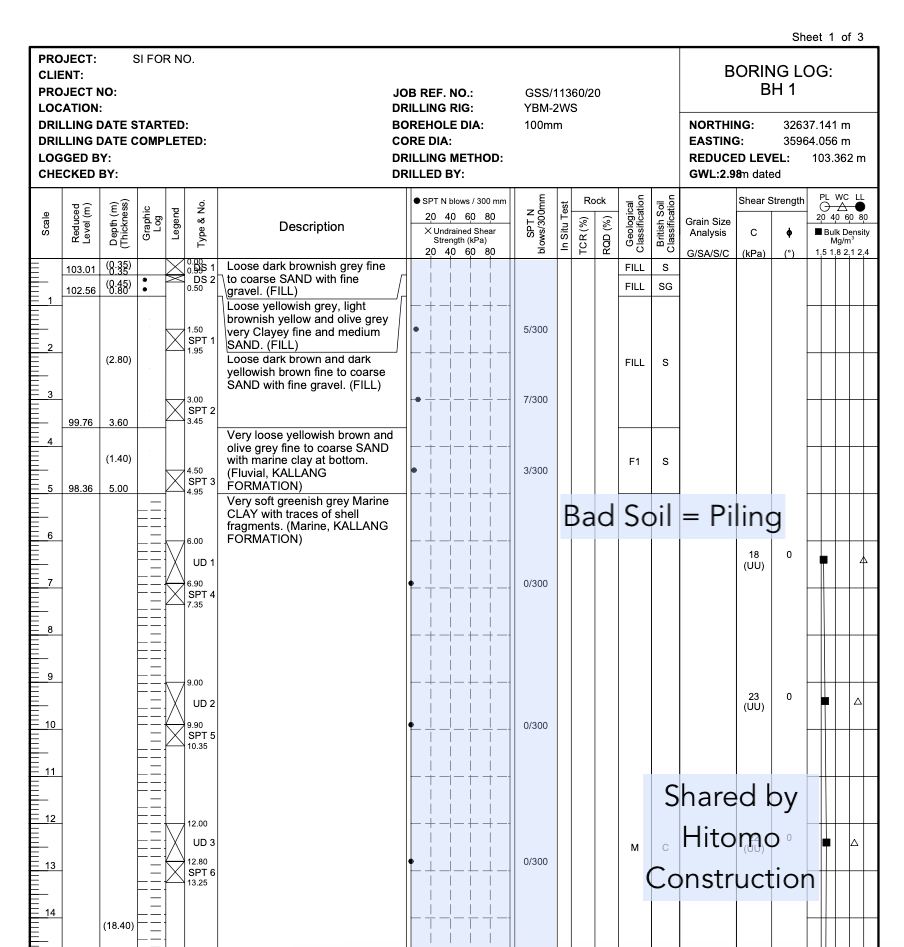
Borehole Log | Visual cross-section of the soil layers at each drilling point |
SPT N-Values | Strength and density of each soil layer |
Soil Description | Clay, sand, silt, gravel, or mixed |
Groundwater Table | Depth at which water is encountered (affects foundation) |
Recommendations | Suggested foundation method: raft, footings, bored piles, etc. |
How to Read the Borehole Log
Imagine the borehole log like a layered cake sliced vertically. It shows:
Topsoil (0–1.5m): Usually soft or mixed fill
Subsoil Layers: May alternate between clay, sand, silty clay, etc.
Depth markers every 0.5m or 1m
SPT N-values indicated beside each depth
Each log entry will include:
Example: Silty CLAY (firm), greyish brown, moist, N=17
Interpreting SPT N-Values
SPT (Standard Penetration Test) is done at regular intervals to check soil strength. It shows how many hammer blows are needed to drive a steel sampler into the soil by 300mm.
N-Value Range | Soil Description | Engineering Implication |
0–4 | Very loose/soft | Poor support, needs piles |
5–10 | Soft clay / loose sand | Risk of differential settlement |
11–30 | Medium dense/firm | May be okay for footings |
31–50 | Dense/stiff | Good bearing strength |
>50 or Refusal | Very dense / boulder / rock | May require socketed piles or excavation |
When High N-Values Are a Problem
Most homeowners assume high N-values = strong ground = good.
That’s not always true.
Here’s why excessively high N-values (e.g. > 50) may indicate problems:
1. Possible Boulder or Obstruction
If refusal happens too early (e.g. 2–3m depth), the pile might not embed deep enough to safely support the house. You’ll need:
Core sampling
New pile layout or raft design
Special drilling equipment
2. Shallow Hard Layer
If a hardpan or rock layer sits too shallow, the foundation may not gain proper anchorage.
This affects structural safety and cost.
Foundation Design Impacts
Depending on the SI report, your engineer may recommend:
Soil Type | Recommended Foundation |
Very soft clay | Bored piles, micro piles |
Loose sand | Raft with deep ground beams |
Stiff clay/dense soil | Footings may be sufficient |
Refusal layer | Socketed piles or rock anchoring |
Questions to Ask Your Builder/Engineer
Is the high N-value due to rock or obstruction?
What’s the depth of stable soil layer?
Will we need longer piles or special pile cap?
Does the soil support raft foundation instead?
🛠 Bonus: Red Flags in Soil Reports
Sudden jump in N-value from 10 → 60 = potential boulder
Constant N=0 for >1.5m = very soft compressible clay
Groundwater table < 1.5m = waterproofing and piling cost increase
Summary Table: SPT Interpretation
Depth (m) | Soil Type | N-Value | Meaning |
0.0–1.5 | Fill | 3 | Soft, unsuitable for footing |
1.5–3.0 | Clayey SAND | 12 | Medium, needs reinforcement |
3.0–5.0 | Silty CLAY | 25 | Firm, possible for shallow footings |
5.0–6.0 | Dense gravel | 55 | Refusal likely — investigate further |
Final Thoughts
Your Soil Investigation Report is not just a technical document — it’s the foundation of your foundation. Understanding it helps you:
Avoid unnecessary rework
Plan construction cost more accurately
Choose the right builder and structural system
Always review your report with your builder and structural engineer before finalizing your construction budget.
Planning a landed rebuild?
Talk to a BCA Grade GB1 builder who designs, submits and builds in-house. Free 60-minute site assessment, no obligation.